
Introduction
Signed, sealed and delivered, yet not always accepted when the signature on the document is electronic (e-signature).
This article is the first in our focused series on Electronic signatures in Trade Credit Insurance (TCI) and Surety, focusing on the legal and practical realities in the EU. It also calls for the necessary steps to address the identified caveats and strengthen e-signature acceptance.
ICISA supports trade digitalisation and recognises that e-signatures are an important part of this process. Beyond legal and operational considerations, ICISA’s commitment to digitalisation is also driven by the broader benefits it brings. These include promoting trade and investment, reducing frictional costs through greater efficiency, and supporting ESG objectives by enabling more environmentally friendly and transparent processes. This article is one of the ways we echo the message that e-signatures should be accepted where security is in place, improving industry practice and supporting EU digital progress.
Regulatory Environment of e-signatures in the EU
The main EU law governing e-signatures is the European Digital Identity Regulation (eIDAS 2.0, 2024, which updates and expands the original 2014 eIDAS Regulation). eIDAS 2.0 regulation facilitates secure cross-border transactions by establishing a framework for digital identity and authentication. These rules apply to both consumers and businesses. It aims to create confidence in electronic interactions and promote seamless digital services in the EU. eIDAS defines three types of electronic signatures: simple, advanced, and qualified, with qualified electronic signatures (QES) offering the highest assurance and full EU-wide equivalence to handwritten signatures. It also sits within broader global developments, including the UNCITRAL Model Law on Electronic Commerce (1996), the UNCITRAL Model Law on Electronic Transferable Records (2017), and ongoing WTO e-commerce discussions. For broader context, see the introductory article in this series.
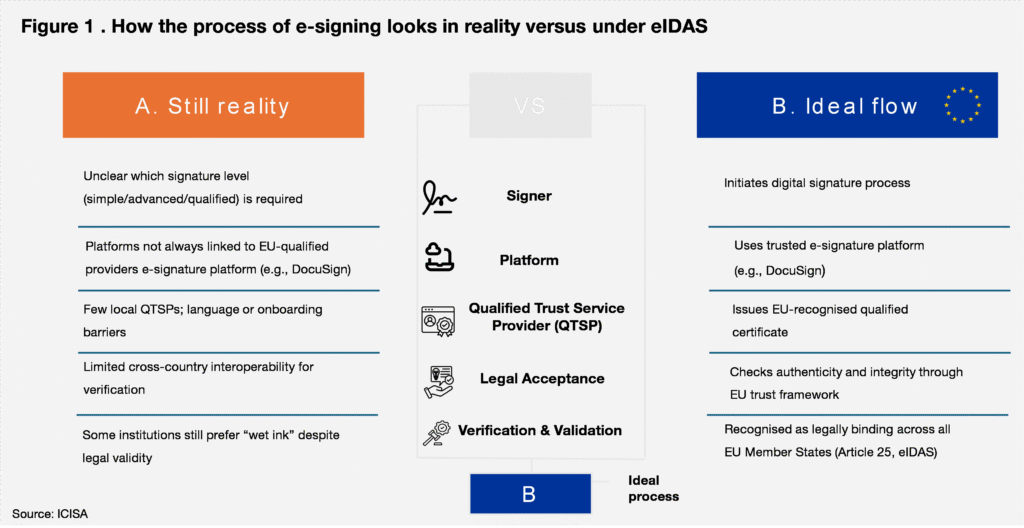
However, eIDAS 2.0 is not perfect. Figure 1 illustrates how the process of electronic signing (e-signing) should work in theory (B) versus where it gets stuck in practice (A). The key issue is that e-signatures have full legal validity and cannot be rejected solely for being electronic. Qualified electronic signatures even carry full EU-wide legal effect. Despite this, stakeholders still sometimes refuse to accept them, not because the law prevents acceptance, but because of how the regulation is structured and implemented.
Surety and TCI implications
For Surety and TCI, the caveats in the e-signatures environment identified in Figure 1 (e.g. unclear signature requirements and limited interoperability) translate into delays, duplicated work, and inconsistent acceptance of otherwise fully valid electronic guarantees and policy documents.
In one reported case, a qualified e-signature issued in full compliance with eIDAS was nevertheless rejected by a national authority because the validation system did not recognise the foreign trust service provider and staff were unfamiliar with the legal effect of qualified electronic signatures (QES), illustrating how legal certainty does not always equal operational readiness.
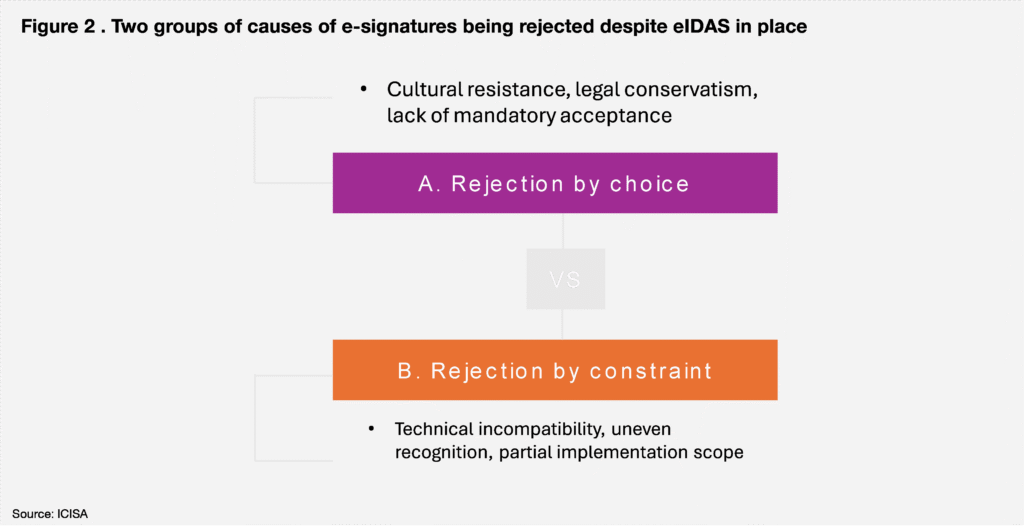
For the purpose of addressing e-signatures rejections, the causes of rejections are categorised into two groups: rejection by choice and rejection by constraint (Figure 2). In the example above, the refusal clearly falls under rejection by constraint. This distinction helps stakeholders understand which problems arise from outdated systems and which stem from habits or risk aversion.
Addressing the challenges of e-signatures rejection
The rejections of e-signatures persist because, although eIDAS legally obliges authorities to accept QES, the Regulation does not include a practical enforcement mechanism. As a result, acceptance depends on whether national systems have been updated to apply the law correctly.
Distinguishing between the two categories of rejection matters because each requires a different approach. Rejection by constraint results from structural issues such as outdated systems or limited interoperability, requiring long-term investment and coordinated upgrades at national and EU level. Rejection by choice stems from awareness gaps and long-standing preferences for paper and can be addressed through clearer guidance, updated internal procedures, and targeted training.
The aim of this analysis is not to criticise eIDAS 2.0. Rather, it highlights the ongoing reality of incomplete acceptance of e-signatures in Surety and TCI, a challenge that slows business processes and prevents the Regulation’s objectives from being fully realised. Recognising these gaps is the first step toward ensuring the Regulation delivers on its ambitions.
Conclusion
Electronic signatures are an important enabler of business efficiency in Surety and TCI. They support faster execution, reduce administrative burden, and strengthen legal certainty. Beyond sector-specific benefits, they also contribute to the broader goals of the European Commission, including digitalisation, simplification of cross-border processes, and more sustainable workflows.
However, these benefits cannot be fully realised until the caveats identified in Figure 1 are addressed. As this article has shown, the obstacles fall into two categories: rejection by choice, which stems from habits, legal conservatism, and a lack of clear acceptance practices; and rejection by constraint, which results from technical incompatibilities, uneven interoperability, and limitations in the current implementation of eIDAS. The first category can be overcome through clearer guidance, consistent procedures, and targeted education, while the second requires structural improvements, investment in digital infrastructure, and coordinated action by Member States and EU institutions.
Strengthening e-signature acceptance is not only an operational issue for Surety and TCI but also a necessary step toward achieving Europe’s wider digital ambitions. Instead of fearing cyber risks or relying on outdated practices, stakeholders should prioritise building trust, adopting robust protective measures, and modernising validation systems. These changes cannot happen overnight, but the transition must continue.
ICISA will continue echoing this message and promoting best practices across the industry to ensure that the benefits of e-signatures are better realised within Surety and TCI.